
This post isn't about an obscure pile of ruins like most of the previous posts. It's about one of the biggest and best-known sites in Nantes, the medieval cathedral. It's also one of the best examples of a Gothic cathedral in France.
I had never been to Europe before I moved to France, and there is nothing like this in Canada. When I arrived in Nantes, the cathedral was immediately the oldest building I had ever seen. The first time I saw it up close was a couple of weeks later, when some of my French colleagues and I were on our way to the university library. I was completely amazed, but they were used to seeing old buildings like this everywhere, so we didn't stop. This happened a few times during my time in Europe - in different cities, I would be amazed by some castle or church or other medieval building, but for them it was nothing special. It's not that they don't care - they do, and historical monuments in France are usually well protected. But these buildings just aren't quite as astounding for French people as they were for me.
The cathedral in Nantes is actually not even very old, for a French cathedral. The oldest parts, the facade and the towers in the picture above, are from the 15th century. I soon found older, Roman and
prehistoric sites in Nantes and elsewhere, but I always liked going back to the cathedral. There always seemed to be something new to discover whenever I went there.
History
 |
The original Gothic cathedral,
Notre Dame in Paris, with its
Christmas tree in November 2011. |
If you picture a medieval cathedral, you’re probably thinking of a Gothic one, like Notre Dame in Paris, the most famous one and one of the oldest. Not every medieval church is Gothic, since that refers to a particular style of art and architecture from the later Middle Ages (about 1200-1500), but Gothic is the style of the biggest and most ornate ones. Of course, no one called it “Gothic” at the time. “Gothic”
was an insult created during the Renaissance by people who
thought ancient Rome was the ideal civilization, and that this “new”
architecture must have been invented by the “barbarians” that had
conquered Rome, the Goths. Obviously, they were wrong! Gothic architecture is a very advanced technological development.
Gothic cathedrals often replaced an older cathedral. In Nantes, as in Paris and many other French cities that dated back to the Roman Empire, the original cathedral was built on the same site as the Roman temple. The first church was built on this spot in Nantes in the 4th or 5th century. This church wasn't a cathedral yet, but a basilica. Today, “basilica” is a technical term for a specific type of church no matter what it looks like, but in Roman times a basilica was a large, rectangular government building with an arched roof. Early Christian churches that copied that style (or that were simply converted government buildings) were also called "basilicas."
 |
| Outline of the baptistry of Nantes' 5th-century basilica. |
Nothing remains of Nantes' original basilica, but on the northwest side of the current cathedral, the outline of part of it is traced on the ground with bricks. This was the baptistry, where baptisms took place. This outline also shows that even though all the churches on this site have been in roughly the same place, they weren't always pointing the same way. The ancient basilica was aligned on a slightly different angle than the modern cathedral. It followed the alignment of the
Roman wall and gate and the modern Rue de l'Évêché.
Since Nantes was a large Roman city, it also had a bishop, and therefore needed more than a basilica: it needed a cathedral. A cathedral is technically nothing more than the seat of a bishop or archbishop (the word "cathedra" is Latin for “chair”). But in reality it usually also means “a really big church”, since bishops and archbishops wanted an enormous and impressive building to reflect the importance of the city and their position. So, a larger cathedral was built on the site of the basilica in the 5th or 6th century, around the same time that the earliest versions of
St-Donatien and
St-Similien were also under construction outside the walls of the city.
This version of the cathedral lasted until the 9th century, when it was attacked by the Vikings. They killed the bishop and burned down the church (as Vikings do). It was rebuilt...then burned down by the Vikings again in the 10th century. The site was in ruins after that, and finally a completely new cathedral was begun in the 12th century.
 |
The apse of the Romanesque church
of Fontevraud Abbey (12th century) |
The new church was built in the “Romanesque” style, an early medieval style that deliberately copied ancient Roman architecture. Renaissance artists weren't the first to think of that - medieval people had already been copying the Romans for centuries! (In French, Romanesque style is simply called “roman” - as opposed to actual Roman architecture, which is "romain".) The only surviving Romanesque church in Nantes is
St-Jacques, on the south side of the Loire in the medieval suburb of Pirmil, but it’s relatively small. A nearby example of a much larger Romanesque church is the famous Abbey of Fontevraud.
Romanesque architecture allowed for the construction of large buildings, but they are very “heavy”, with a lot of thick walls to help hold keep the whole building standing, as you can see at Fontevraud. When the Gothic style was developed, it allowed for even bigger churches that were “lighter” and had more windows and open spaces. You can see the difference in the apse (or chevet) of Fontevraud and Nantes (i.e. the collection of chapels behind the altar inside). At Fontevraud, for example, the chapels themselves are the walls of the church. They are heavy and thick, so that they can support the other parts of the church built on top of them.
In a Gothic cathedral like Nantes, the walls are held up by “flying buttresses”, pillars that support the walls by leaning against them from the outside. This means that the walls can be thinner, lighter, and much taller, with more windows to let more light inside. Without the buttresses, the thin walls would collapse from the weight of the roof. They're hard to see in this picture because there are trees everywhere, but here is another image of the apse and the buttresses in Notre-Dame (which really are medieval; Nantes' apse was actually built in the 19th century).
 |
| The apse and buttresses of Nantes Cathedral. |
 |
The apse of Notre-Dame in Paris,
and its flying buttresses. |
 |
| The Romanesque crypt. |
Like the original basilica, almost none of the Romanesque cathedral remains either, except for the crypt located under the altar of the current cathedral. The crypt is a museum now, which is accessible by passing through the more recent crypt from the 19th century. There are columns and other bits of Romanesque architecture there. It's very small and very dark (or "spooky", as my son described it).
There must be photographs of the remains of Nantes' Romanesque cathedral
before it was completely torn down, as the Gothic one was only completed in the late 1800s. I've never seen any, but I imagine it must have
looked something like Fontevraud.
The Gothic cathedral
 |
| The 15th-century towers. |
When part of the cathedral was destroyed by fire in the early 15th century, the bishop and the duke decided to rebuild the whole thing in Gothic style. By then, the Duchy of Brittany was relatively wealthy and powerful, and was still an independent country, not yet officially integrated into the Kingdom of France. Construction on the new church began in 1434.
Bigger, more ornate Gothic buildings also required more time and money, and as was often the case, it took centuries to finish building this version of the cathedral in Nantes. Some Gothic churches took up to 600 years to complete. Some have never been finished. In Nantes, construction took 457 years.
 |
Some construction work on the south
side of the cathedral in 2012. You can
see the outline of an old building
under the current pavement. |
|
The front towers were the first to be completed in the 15th century, and the rest was constructed at various times throughout 16th, 17th, and 18th centuries. By then, the rest of the city had long since expanded around the cathedral and outside of the Roman and
medieval walls, so at last the final bits of the Romanesque church were torn down and the cathedral was completed in 1891. Some cathedrals that were built over many centuries are a mix of different medieval, Renaissance, Baroque, and other modern styles. But in Nantes, the whole church looks like it was built all at once during the Middle Ages.
Although construction officially ended in 1891, there always seems to be work going on. The area was damaged by Allied bombing several times during World War II, when Nantes was an important Nazi port in occupied France. In 1972, the roof caught fire, and had to be entirely rebuilt. The towers were cleaned a few years before I was there, and the north side was undergoing some major repairs during the couple of years I lived there. It takes a lot of work to maintain an almost 700-year old building!
Exterior
 |
The Armistice Day parade, November 11, 2011, to give
an idea of the relative size of the cathedral. |
The cathedral is located in a wide open square, Place St-Pierre, surrounded by typical 19th-century Second Empire townhouses. The façade of the cathedral consists of two towers, each with two sets of doors (one on the front and one on each side), and a larger main portal in between. This the medieval core of the church, the first part to be completed in the 15th century. The towers are 63 metres high, which is rather large for a Gothic cathedral, although not as high as the towers of Notre Dame in Paris.
In Paris, you can climb to the top of Notre Dame, but you can't climb the ones in Nantes. According to the friendly old man at the welcome desk inside, the stairs have never been renovated and are too rickety and dangerous to open them up to tourists like they did in Paris. Only construction workers are allowed up there, and they need a special kind of insurance first. I can think of at least one occasion where someone did climb up without permission - during World War II, the French Resistance planted a French flag on top of one tower. Construction workers were also up there sometimes while I lived there, and the tourist office has pictures on its website that are obviously taken from the top of the cathedral. But regular people can't go up there.
Portal
Supposedly there is a date carved into the stairs outside the main portal, the date the first stones were laid in the 15th century. I was never able to find that inscription, but other interesting things are visible outside. There is a statue of St. Peter, and the portal is covered with Biblical scenes. The idea is that this was the "poor man's Bible" - since the majority of medieval people couldn't read, churches and cathedrals had lots of sculptures and images to explain Biblical stories. The front doors usually have carvings of the Last Judgement (as they do here, and in Paris).
Beside the portal there is a pulpit, which is unusual for a French cathedral. Here, the priest or the bishop could preach to crowds in the square.
Another unusual aspect is the window above the portal. It looks more like the window of an English cathedral, an arched rectangle. French cathedrals usually have at least one circular window, a "rose window", as you can see in the image of Notre Dame above (Notre Dame actually has three of them).
 |
The coat of arms of the Duke of Brittany,
above the portal. |
Transept
 |
South transept window (the north side
was always covered by scaffolding when
I lived there). |
Cathedrals are usually built to look like a Christian cross. The main part (the portal, the nave, the apse) usually runs from west to east, so that the altar would theoretically be facing east towards Jerusalem. The bar of the cross is the "transept". At Notre Dame there are two more circular rose windows at either end of the transept, but Nantes has no circular windows at all. Instead, both sides of the transept are filled with a long rectangular window.
Unfortunately, the original windows were destroyed either in 1800, when a tower filled with gunpowder exploded in the nearby castle, or by the Allied bombing in 1943.
 |
| North transept from the inside. |
 |
| South transept from the inside. |
Gargoyles
Another way to distinguish the various parts of the cathedral are the gargoyles. They aren’t as ornate as the gargoyles on Notre Dame (which aren’t medieval anyway, they're from the 19th century), but the ones at the front are definitely older and almost worn away, while the ones closer to the apse are obviously newer and still very detailed.
 |
| 19th-century gargoyle at the east end. |
 |
| 15th-century gargoyle at the west end. |
Graffiti
 |
| Graffiti from 1763. |

This is a minor point, and something that is not even supposed to be there at all, but it's something that always made me think about how different parts of the world are linked at different times in history. On the north side of the cathedral, near the line of bricks on the ground marking the location of the original Roman basilica, there is also some 18th century graffiti – someone scratched his name (Colin?) into the stones in 1763. For me, as a Canadian, that was also a significant year – the Seven Years’ War (or the French and Indian War) ended with Britain taking control of all of New France. Afterwards, colonists were forbidden from settling on Native land, and American settlers were forbidden from moving into the newly-conquered territory, which was eventually one of the causes of the American Revolution. The cities where I have lived in Ontario, London and Toronto, did not even exist yet in 1763. But at the same time in Nantes, someone carved the date into the cathedral that had already been there for many centuries, in a city that had existed for probably over 2000 years.
Old graffiti is really very exciting for some reason. Canterbury Cathedral in England has even older graffiti carved into the pillars on the inside - here is an example of some from 1667 and 1670. There is also graffiti all over the castle in Angers (I couldn't get any photos of it, but some of it was carved by German soldiers when it was used as a Nazi base).
Around the cathedral
 |
| La Psalette. |
Attached to the southeast corner of the cathedral, near the remnants of the medieval wall, there is another large Gothic building, La Psalette. It was originally an ecclesiastical residence, then home to a music school (for singing the Psalms - hence the name Psalette). There's a chapel inside, but I never had a chance to go in.
Some other interesting events happened to take place in or around the cathedral. For example, in
1661, King Louis XIV's finance minister was arrested in front of the cathedral by
the captain of the musketeers, D'Artagnan. He's better known from the
fictional novels about the musketeers, but he was a real person.
 |
| Lit up at night in 2012. |
As I mentioned above, the French Resistance planted a flag on top of the cathedral during the Nazi occupation. In 1942: the German commander of the city, Karl Holz, was assassinated in front of the cathedral. In response, the Nazis executed 50 prisoners, who are today commemorated as
the "Cinquante Otages". Outside of the ancient and medieval stuff, I think this is one the most interesting story in Nantes' history, and I'll have more to write about it in the future.
 |
The cathedral and Place St-Pierre, as seen from the
observation deck of Tour Bretagne. |
Interior
 |
| Nave of Nantes Cathedral |
I lived just a few minutes away from the cathedral, so close that I could hear its bells chiming the hours. I walked past it
every day on the way to work and back - it may not have been the shortest route to work, but I liked walking through the Roman and medieval core of the city. I often went inside the cathedral, just to hang
out and look at all the cool medieval (and modern) stuff, and to take hundreds and hundreds of pictures.
The inside of the cathedral is as consistent as the outside - it all looks medieval. From the entrance, you can look straight towards the apse, which appears to be much closer than it actually is. This is a trick of Gothic architecture, where the very tall columns and high ceiling disguise the length of the nave.
The nave is actually 103 metres long, and 37.5 metres high. For comparison, this is shorter than Notre Dame (130 metres long), but a bit taller (Notre Dame's nave is 33 metres high). The nave of the Gothic Canterbury Cathedral in England is only 24 metres high. The illusion is even more impressive there - it seems much taller than Nantes or Notre Dame, because it is much longer, 160 metres.
 |
| Nave of Notre Dame in Paris |
 |
| Nave of Canterbury Cathedral |
 |
| Nave of Angers Cathedral |
 |
The other end of the nave,
looking towards the organ and
entrance. |
These photos also show the differences between Romanesque and Gothic architecture inside a cathedral. The nave of the Romanesque Angers Cathedral is also 24 metres high, but it is only 90 metres long, so it seems smaller. It's impressive for other reasons, but Angers also does not have the much higher columns and generally lighter and brighter architecture of the later Gothic cathedrals, which makes it seem darker and smaller inside.
But back to Nantes! The most interesting medieval things are, naturally, right at the entrance, the oldest part of the cathedral. Just inside the door there is the musty smell of old wood, stone, smoke and incense that you find in every medieval church. The doors look like they might be the originals, and on either side are statues of the patron saints of Nantes, Donatian and Rogatian. There are also statues of various characters from the Bible, as well as St. Clair, the first bishop of Nantes, and Duke John V, who funded the construction of the cathedral in the 15th century. There are sculptures depicting scenes from the Bible, sometimes with a French explanation carved into them.
 |
The doors, with statues of Donatian, Rogatian,
and Old Testament figures. |
 |
| Duke John V |
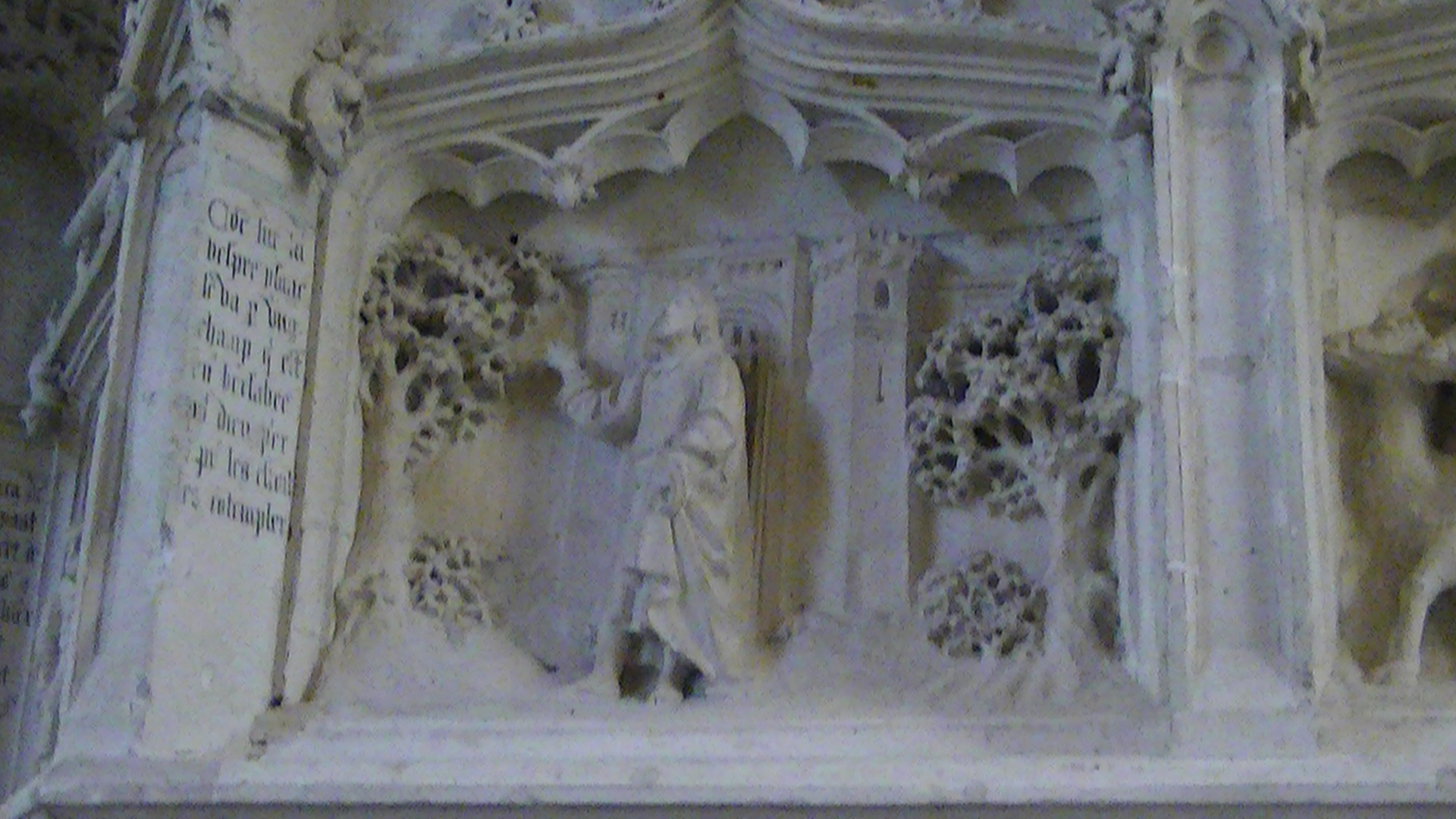 |
| A carving depicting a scene from Genesis. |
 |
| And the text, in Old French. |
 |
Another inscription, about the "foundation of the Mass",
from the 16th century. |
Vaults
Another distinguishing feature of a Gothic cathedral is the "rib vault". The vault is basically the ceiling, the upper end of the columns holding the church up. A rib vault was a new invention that allowed the ceiling to be built much higher, or to give the appearance of being much higher. For example, in the photo of Angers Cathedral above, the older kind of vault had to fan out from the columns much closer to the ground in order to support the weight of the room. With Gothic rib vaults, the columns were stronger, so the roof could be built higher.
 |
| Rib vaulting |
|
|
|
 |
Detail of vaulting. This detail is not original, as the
ceiling/roof was restored after the fire in the 1970s. |
Tombs and memorials
There are a few tombs and
burial spots marked inside the cathedral. The biggest one is the tomb of Francis
II, Duke of Brittany, and his wife Marguerite de Foix. The tomb was
commissioned by their daughter, the famous Anne, who was married two kings
of France and whose lack of male heirs led to the unification of Brittany and France. The tomb was sculpted by Michel Colombe.
 |
| Tomb of Francis II and Marguerite of Foix |
 |
| Detail of Francis and Marguerite. |
There
is also a large cenotaph for General Christophe de Lamoricière, who
participated in the French conquest of Algeria in the 1840s, and was
part of the coup against Louis Napoleon in 1851. He was also a commander
of the army of the Pope, fighting against the unification of Italy in
the 1860s.
 |
| Cenotaph of General Lamoricière |
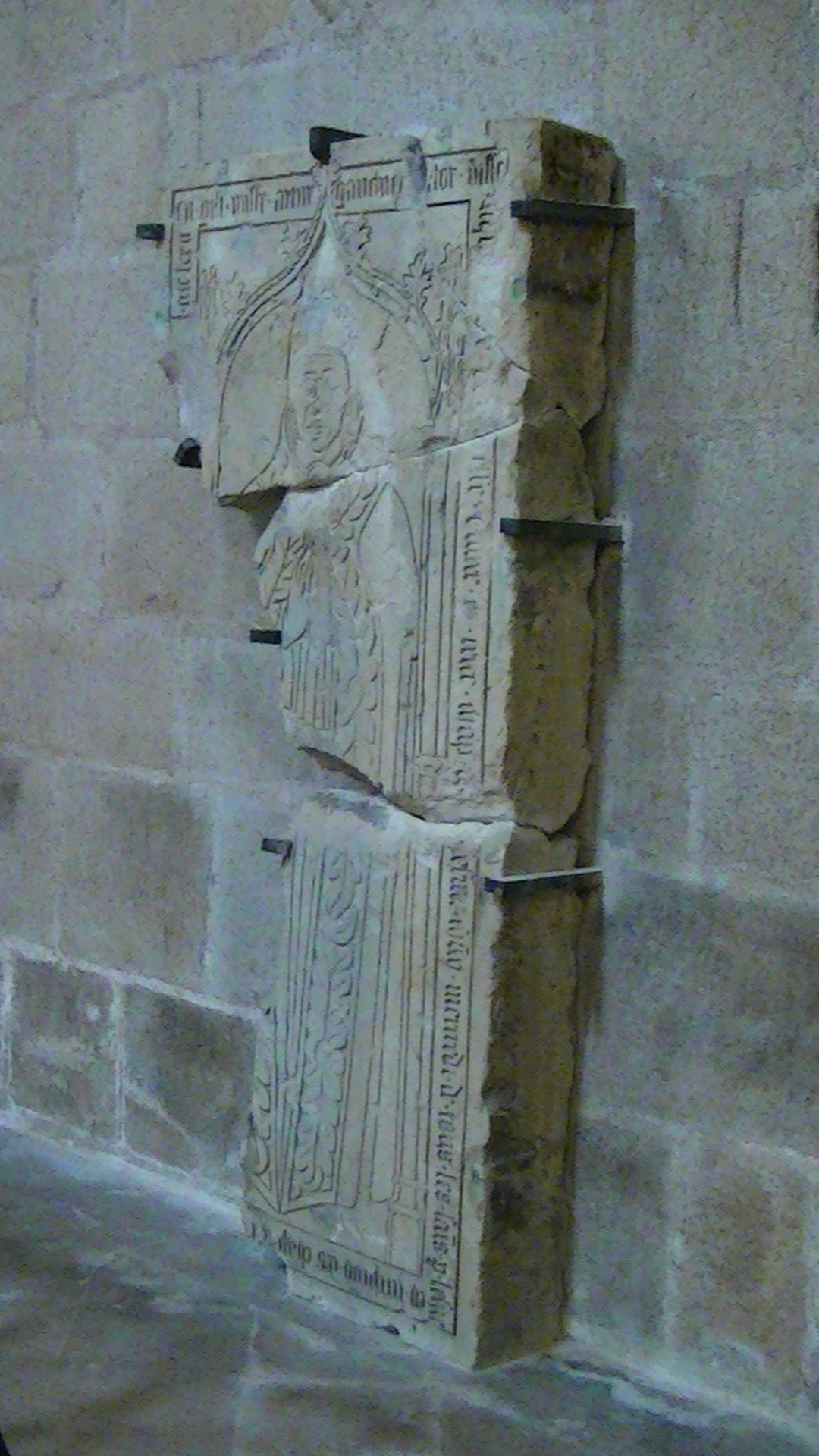
Other memorials include remnants of the tombstone of a priest that were found outside the cathedral, and a memorial to British Empire soldiers who fought in France during World War I. The same memorial is also in Notre Dame in Paris, and numerous other cathedrals throughout France.

The 19th-century crypt was also intended to be the burial place of the bishops of Nantes, but I don't think anyone is actually buried there. When I was there, it contained a display about the history of the city and the cathedral.
 |
| Nineteenth-century crypt |
Chapels
There are a dozen or so "lateral chapels" along the north and south sides of the cathedral (and in the apse).
Some of the chapels are relatively recent and intact. Some of them are dedicated to a particular person or saint, but they are currently empty. Some of the older chapels near the front of the church existed at the time of the French Revolution, and were destroyed or defaced. The Revolutionaries were opposed to the power of the church under the old regime, and many churches were destroyed entirely during the Revolution, including some in Nantes. The chapels of St. Clair, St. Felix, and St. Donatian and Rogatian were defaced and the statues in their were destroyed. They are still used as chapels, but they have never been restored.
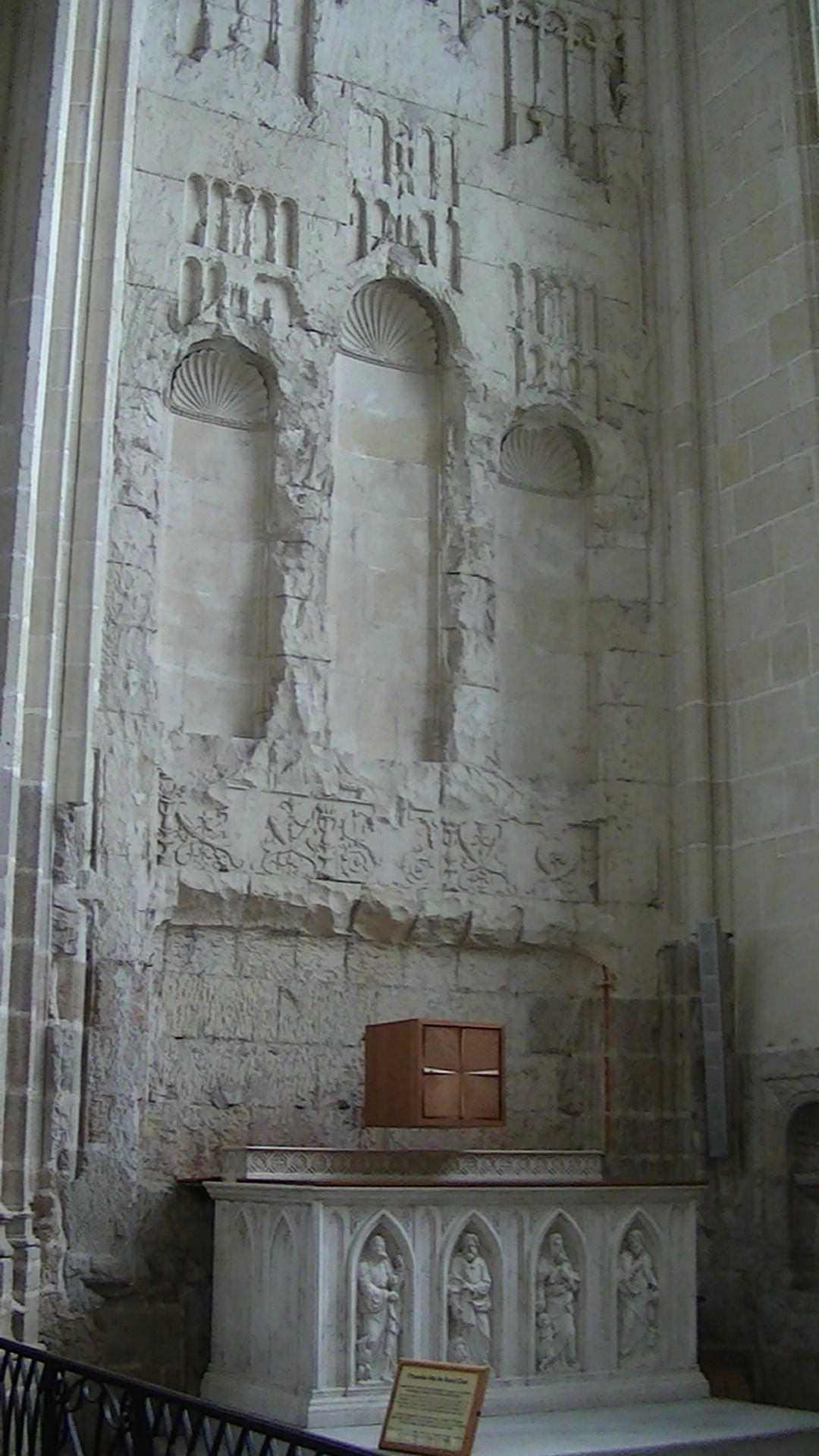 |
Chapel of St. Clair, the first bishop
of Nantes. |
 |
| Chapel of St. Donatian and Rogatian |
 |
| Chapel of St. Felix |
 |
| Chapel of Françoise d'Amboise |
 |
| Chapel of Our Lady of Pity |
 |
| Chapel of St. John the Baptist |
 |
| Chapel of St. Joseph |
 |
| Chapel of St. Martin of Vertou |
 |
| Chapel of St. Yves |
 |
| Chapel of the Virgin Mary |
 |
| Chapel of Sacre-Coeur |
 |
| Chapel of St. Gohard |
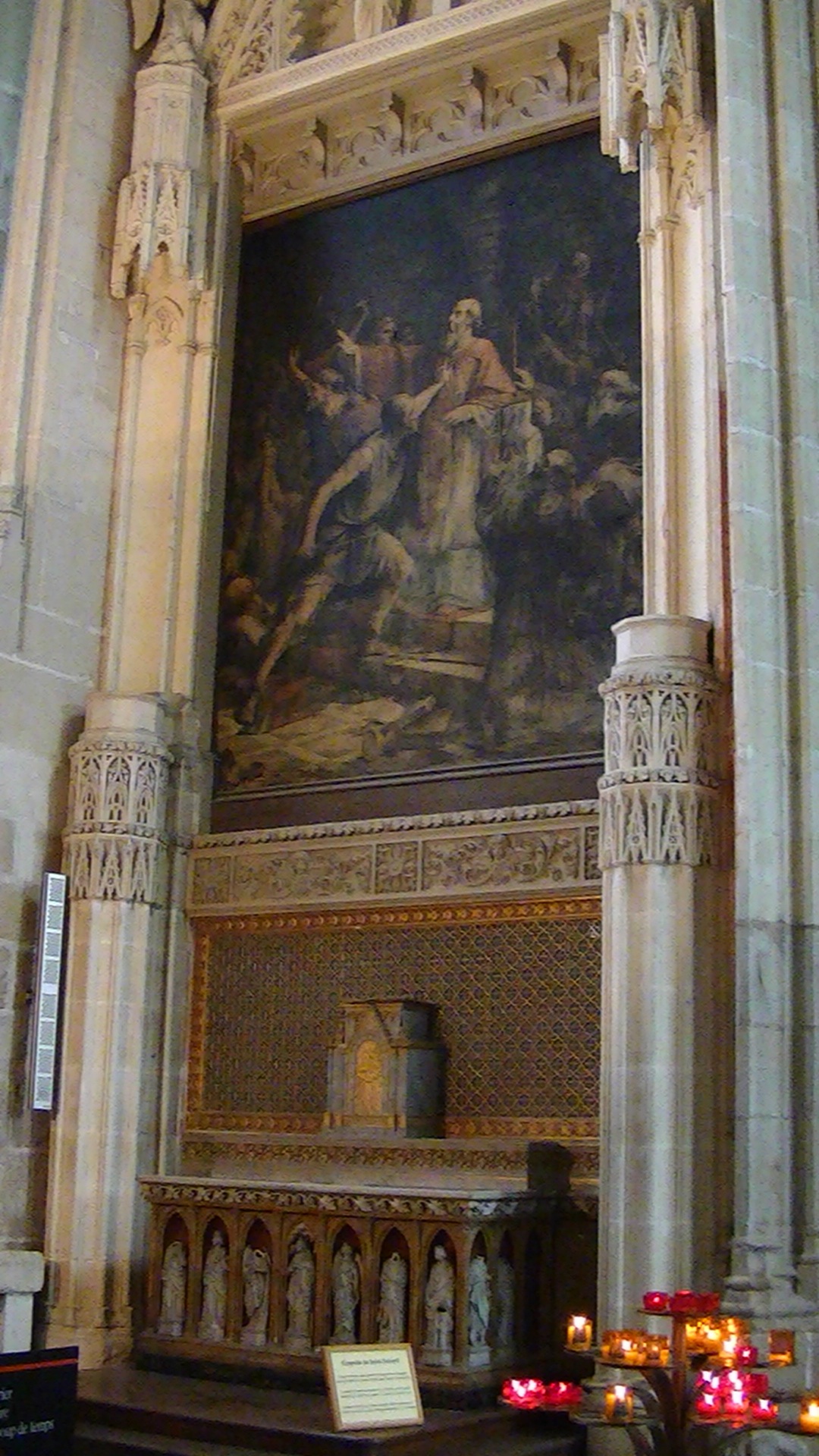
One chapel is also dedicated to St. Gohard, who was bishop of Nantes when the Vikings invaded in the 9th century. ("Gohard" is not the only way to spell his name, but it is clearly the best way.) This chapel has a modern painting depicting his assassination by the Vikings. As the story goes, the people of Nantes took refuge in the cathedral, and Gohard was celebrating mass when he was killed on the altar.
That is all for the cathedral. Next, there are still some other smaller churches and religious buildings to write about, including some that no longer exist.






.jpg)




.JPG)


